In the video game industry there are 4 main ethical concerns that are commonly brought up: violence, religion, gender representation and racism.
Gender Representation
In 2012 the Entertainment Software association did a survey of game players where they discovered that 45% of gamers are female, with a figure like that you're probably wondering why this is even an issue in the video game industry. Well seeing as this number includes the 74% of women who play games like 'Angry Birds' or 'Candy Crush Saga' on their phones meaning they are 'casual gamers', it would be more accurate to say that 12% of gamers are female, which is where the controversy arises. The lack on women playing video games has made it so a lot more games are made with men in mind, this resulted in negative claims being made that game creators are sexist and purposely choose to alienate the female audience but I believe this isn't true. Although some games like the 'Dead or Alive' franchise use women as sex objects, female characters in other games such as Elizabeth from 'Bioshock Infinite' and Samus from the 'Metroid' franchise being strong, independent women who are the highlight of their respected games and are good role models for women or anyone for that matter; and for quite awhile now popular video game franchises like 'Halo' and 'Pokémon' give the player the option to choose their character's gender, saying that game developers are being sexist and are alienating women is just inaccurate.
Violence
Violence has been around in video games since the 1976 game 'Death Race', as video games developed and improved overtime the graphics became better and the violence became more detailed; members of the public became concerned that video games were making people become more violent, especially children as they are more influential to do what they see. To quote Dr. Craig A. Anderson: " Violent video games are significantly associated with: increased aggressive behaviour, thoughts, and affect; increased physiological arousal; and decreased pro-social (helping) behaviour.", to put that into Laymen’s terms: violent video games make people bad; when looking at games like 'Dead Rising 2' where you shove axes into people’s spines and 'Call of Duty Modern Warfare 2' where you perform a massacre at a Russian Airport, it's safe to say that video games can be incredibly violent. This has resulted in many people finding the video game industry one of violence and corruption, something that is turning people into murderers; there are even anti-video-game activists like Jack Thompson who dedicate their lives to censoring and banning video games due to their effects on children and others. Video-game-activists do appear to raise a fair point at first though, incidents such as the Columbine High School massacre where two boys killed teenagers at their school support the theory that video games are bad as the two who committed the crime liked to play violent video games; however like a magic trick if you do the research the trick is ruined, when you get down to it it's not the video game developers fault that a violent game made your under-age child violent, it's the fault of the parent who buys their under-age child a violent video game! If the child's parent said "No." when buying the game then they wouldn't have turned violent, it's the same with normal people, although a game could make you violent it's your fault for lacking self control and acting out highly inappropriate/illegal things; besides, violence has existed for a lot longer than video games have, if people like Jack Thompson blame 'Halo 3' or 'Mortal Kombat' for making people violent, then I'd love to know what video game people played back
during The Crusades some 1000 years ago.
Religion
Religion is a highly controversial subject in any form of media, video game developers usually avoid pushing their luck when using it in games, however that's not to say that controversies don't arise from time to time. Creationism groups claim that the 'Pokémon' game franchise is brainwashing players to believing in evolution, and 'LittleBigPlanet' made Islamic gamers deeply offended when one of its songs had words from the Holy Quran. Religious insensitivity have never really had quite as big an impact on the industry as violence, gender representation and racism; however it has had an impact on how some developers in the video game industry work it into their creations, the 'Final Fantasy' series for instance uses religious themes and imagery to educate the western world of how religion is practised as a mixture in Japan, other game developers use religious icons such as those of Norse mythology to inject a touch of flavour and familiarity to the game. Although religion can be used in bad ways, in the video game industry it is mostly used to enhance the experience, not to offend; this makes the media format very unique and culturally diverse, one that anyone can enjoy.
Racism
Once upon a time, racism was virtually non-existent in the video game industry, however in recent times it's
become quite common. In 2002 there was a video game called 'Ethnic Cleansing' where the player has to go around killing African-Americans, Latinos, Jews and the Prime Minister of Israel to win the game; the 5th 'Resident Evil' game has you killing Africans in small villages, and of course there's 'Call of Duty' which has been painting a negative picture of Russian people for years now! Although not a lot of video games are racist, a lot of the players are from being subjected to them, if you go on a 'Call of Duty' or 'Battlefield' online game and speak to other players in a non-American accent then prepare to have tonnes of racist comments thrown your way; the amount of people who be racist when playing video games has given the industry (although mostly Microsoft and Sony as the XBOX 360 and PlayStaion 3 are where this sort of thing happens the most) a bad image and have attracted attention from groups such as the Anti-Defamation League and Red Cross to make it stop. This has had a dramatic effect on the video game industry, video game developers are afraid to do things in case they are called out for being racist, Nintendo had to change the 'Pokémon' character design on 'Jynx' because it looked like black face; the media has been surprised but in this case I believe for the better, unlike the other subjects I've talked about, racism in video games does but should not exist.
To put an end to all this madness
and controversy, the ‘Comics Magazine Association of America’ (or ‘CCA’) was
formed and created the ‘Comic Code Authority’ (or ‘Comic Code’), this was a
system that made sure comic books being published didn’t contain any inappropriate
content; all comic book publishers at the time would submit their comics to the
CCA who would check them for inappropriate material, if the comic passed they
would authorize the use of their seal on the cover so that the public knew the
comic would be okay to read. By the
early 2000s most new publishers decided not join the CCA as it meant adverts
for products for older people (such as 15+ films or energy drinks) could not be
advertised in them. In 2001 Marvel were suppressed by the CCA from releasing
'X-Force' #116, this was due to the comic featuring heavily detailed graphic
violence as well as some 'implied sexual content' (according to the CCA),
Marvel editor Axel Alonso and artist Mike Allred stated that they 'went all out
to make readers feel the impact of the violence' as it was very important to
the story and overall future of the series; Marvel refused to remove it so they
withdrew from the CCA, released 'X-Force' #166 without a CCA seal of approval
on the cover, and they started to work on their own rating system based on age
groups like the 'BBFC' does. This was the 'Marvel Rating System', it follows
almost identical guidelines as the CCA did for what is deemed appropriate and
inappropriate, however instead of banning any inappropriate content from being
published, they give the comic it’s featured in a rating that specifies the comic
is for older audiences. Here is the guidelines for what comic gets what rating:
Pre Civil Rights Movement comic
books were a cesspool of racial insensitivity, this wasn't particularly due to
comic book publishers being racist or hateful but rather them following the cultural
norm of what was socially acceptable for the time. The main victims of racism
in comics were the Black British population and Germans, the Black British
population were depicted with pitch dark skin, big eyes, and big red lips, they
also performed menial jobs such as butler and janitorial work while eating watermelon
and chicken, as these were the traits of popular minstrel show performers of
the time it only made sense for comic book publishers to base the character designs
after them; as World War II was happening at the time the Germans were depicted
as being cowardly, bumbling, idiots who would act like poorly behaved children,
as war propaganda depicted Germans like this it made perfect sense to treat
them in the same way in comics. An example of racial discrimination would be
'Captain Marvel Adventures' #23
which features a Black British character called
'Steamboat', in the comic he is drawn as monkey-faced doofus with the facial
features mentioned previously, he is also conveyed as being unintelligent as
his dialogue is written in such a poor way, indicating he is saying these words
in an idiotic voice making him seems like a character to be ridiculed; by doing
this Marvel enforced a negative racial stereotype of Black British people,
affecting the minds of the children reading the comics, making them racist and
enforcing Dr. Frederic Wertham's theory of comic books being evil. Thankfully
these outdated racist views have disappeared from the comic book industry, it
now focuses on bringing racial harmony amongst the readers and making the
comics more accessible and appealing to people of other nationalities and those
who live in other countries. For instance: Marvel have recently released the
'Ms. Marvel' comic book franchise which has the main protagonist as a teenaged
Muslim Girl from Pakistan living in America, in the comics she is portrayed as
an average female teenager who immigrants from Pakistan to New Jersey and is
experiencing a culture shock, her storyline and multicultural routes have
turned her into a relatable role model amongst female Muslim readers, this has
helped the new franchise become popular all around the world and has made the
character and Marvel very respectful and famous.
Gender Representation
 |
| The 'casual' mobile phone game 'Angry Birds' |
 |
| The option to choose your gender at the beginning on 'Pokemon X and Y'. |
Violence
 |
| Jack Thompson, the anti-video-game activist who tries to ban violent video games. |
during The Crusades some 1000 years ago.
Religion is a highly controversial subject in any form of media, video game developers usually avoid pushing their luck when using it in games, however that's not to say that controversies don't arise from time to time. Creationism groups claim that the 'Pokémon' game franchise is brainwashing players to believing in evolution, and 'LittleBigPlanet' made Islamic gamers deeply offended when one of its songs had words from the Holy Quran. Religious insensitivity have never really had quite as big an impact on the industry as violence, gender representation and racism; however it has had an impact on how some developers in the video game industry work it into their creations, the 'Final Fantasy' series for instance uses religious themes and imagery to educate the western world of how religion is practised as a mixture in Japan, other game developers use religious icons such as those of Norse mythology to inject a touch of flavour and familiarity to the game. Although religion can be used in bad ways, in the video game industry it is mostly used to enhance the experience, not to offend; this makes the media format very unique and culturally diverse, one that anyone can enjoy.
 |
| Nintendos response to the racial issue surround the Pokémon 'Jynx'. |
become quite common. In 2002 there was a video game called 'Ethnic Cleansing' where the player has to go around killing African-Americans, Latinos, Jews and the Prime Minister of Israel to win the game; the 5th 'Resident Evil' game has you killing Africans in small villages, and of course there's 'Call of Duty' which has been painting a negative picture of Russian people for years now! Although not a lot of video games are racist, a lot of the players are from being subjected to them, if you go on a 'Call of Duty' or 'Battlefield' online game and speak to other players in a non-American accent then prepare to have tonnes of racist comments thrown your way; the amount of people who be racist when playing video games has given the industry (although mostly Microsoft and Sony as the XBOX 360 and PlayStaion 3 are where this sort of thing happens the most) a bad image and have attracted attention from groups such as the Anti-Defamation League and Red Cross to make it stop. This has had a dramatic effect on the video game industry, video game developers are afraid to do things in case they are called out for being racist, Nintendo had to change the 'Pokémon' character design on 'Jynx' because it looked like black face; the media has been surprised but in this case I believe for the better, unlike the other subjects I've talked about, racism in video games does but should not exist.
The Comic Book Codes of Ethics
Unlike the video game industry,
ethics and legal issues have always been a predominant subject in comic
book publication. In the early days of the comic book media, there were no guidelines or laws suppressing comic books from including material which could be seen as insensitive, as comic books were aimed at a young audience there wasn't much inappropriate material, it didn't take long for the media became host to violence, crime and sexual situations; Dr. Frederic Wertham started to notice a connection between juvenile delinquents and comic book reading so he concluded that the inclusion of this inappropriate content was corrupting Americas youth which started an attack on the comic book industry. This was when things became really bad, comic books were banned, recycled and even publicly burned in some cities across America; to quote Dr. Wertham when he spoke to the 1954 U.S. Senate Subcommittee Hearing on Juvenile Delinquency: “I think Hitler was a beginner compared to the comic-book industry.”
book publication. In the early days of the comic book media, there were no guidelines or laws suppressing comic books from including material which could be seen as insensitive, as comic books were aimed at a young audience there wasn't much inappropriate material, it didn't take long for the media became host to violence, crime and sexual situations; Dr. Frederic Wertham started to notice a connection between juvenile delinquents and comic book reading so he concluded that the inclusion of this inappropriate content was corrupting Americas youth which started an attack on the comic book industry. This was when things became really bad, comic books were banned, recycled and even publicly burned in some cities across America; to quote Dr. Wertham when he spoke to the 1954 U.S. Senate Subcommittee Hearing on Juvenile Delinquency: “I think Hitler was a beginner compared to the comic-book industry.”
 |
| Dr. Frederic Wertham. |
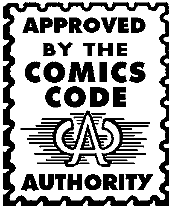 |
| The 'Comic Code Authority' logo, this was put on the cover of all comics approved to be published. |
·
ALL AGES - This means the comic is appropriate
for anyone of any age to read, this comics will have no inappropriate material
present in them.
·
A - The comic will be appropriate for anyone
aged 9 and up, this means there may be minor instances of mild violence but
nothing to get concerned about.
·
T - This is the Marvel equivalent of a 12A film
rating, meaning it's appropriate for most readers 13 and up, but parents are
advised that they might want to read beforehand to approve it's okay for their
child. Violence, sexual innuendos vulgar language will be included.
·
T+ TEENS AND UP - Appropriate for older teens;
violence, sexual innuendos vulgar language will be included like with the 'T'
rating but without a parental advisory.
·
PARENTAL ADVISORY - These are essentially 'T+
TEENS AND UP' rated comics that feature more mature themes and detailed graphic
imagery of violence, sex and other adult situations. For teenaged readers it is
advised that that a parent reads it beforehand to approve it's appropriate for
their child (as with the 'T' rating).
·
EXPLICIT CONTENT - These are comics that are for
18+ mature readers only; they feature heavy amounts of strong violence, various
types of sexual activity, discriminating behaviour, adult language and graphic
blood and gore. Due to the adult nature of these comics you'll never find them
on newsstands and will not be marketed to younger readers in any way, to help
parents identify these comics there will be a 'MAX Comics' logo on it; 'MAX
Comics' are an alias for 'Marvel' which they use for 18+ comics, no main
'Marvel' franchises will be 'MAX Comics' so as not to expose children to mature
content.
By withdrawing from the CCA and
establishing their own refined rating system, Marvel became able to publish
anything they chose to in their comics with no art, story and advertising
limitations at all; due to the new found freedom of including mature material
as well as the increase in revenue this system created for Marvel, other
companies followed suit and started making their own rating system, by 2011 the
CCA was abandoned all together, allowing the industry to flourish into what we
know it as today.
 |
| 'X-Force' #116 cover art. |
Racism
 |
| The front cover of 'Captain Marvel Adventures' #23. |
 |
| A panel from 'Captain Marvel Adventures' #23 detailing the racist portrayal of Black British. |
 |
| 'Ms. Marvel' #1 cover art. |
If anything then, the comic book
industry is one that does everything it can to avoid controversy and focuses on
equality amongst all peoples of the world, and there is no better proof of this
than Marvel's 'X-Men' franchise. The central theme and moral of the 'X-Men'
franchise is based upon the concept of tolerance and acceptance, it teaches
equality with the story premise that regardless of your background, appearance,
talents, abilities, skin colour or gender, a person can become a member of the
X-Men; this plot point is used to teach readers racial tolerance, it tells
readers that no one group of people is superior than the others, that everyone
is equal and has the potential to be special, promoting equality amongst all peoples.
 |
| A group shot of the X-Men. |

No comments:
Post a Comment