When it comes to the media industry, there are many areas of work, the
major sectors of the industry are:
·
Film - The collective creation and distribution
of feature length sound and moving image productions via cinemas, the internet
and home media. Universal Studios is a major company in the film industry that
has been creating and distributing films for over 100 years!
·
Television and Radio - The collective creation
and distribution of sound and moving image productions through analogue and
digital transmissions which are picked up and made accessible to the public
through home media devices such as set-top boxes and personal radios. One of
the most popular television and radio companies is The BBC which has been
providing its services of quality media through television and radio the Great
British public for 91 years.


·
Interactive Media - A specialised media that
relies on a user's input to provide a products output, it engages the user the
product and allows them to interact with what's happening with a controller of
some kind; the internet, video games and home media devices like DVD players
are considered interactive media.
·
Video Games - The dominant variant of
interactive media, users are fully immersed in an enjoyable interactive
experience by using a controller to play out an adventure; they are extremely
popular and are distributed on cartridge or disc based platforms that run on
video game consoles like the Nintendo 64 and the SEGA Mega Drive.
·
Animation - A specialised area of the Film,
Television, Interactive Media and Video Games industry which is all based
around creating the illusion of movement through a series of moving images
created by hand or on a computer.

·
Publishing - The preparation, issuing and
distribution of printed media for sale to the general public; these
publications can be books, magazines, research papers and many other forms of
print media.
·
Press - The press is a section of the mass media
industry that focuses on presenting current news to the public via television,
radio, interactive media and publishing.
·
Advertising and Marketing - Advertising and
marketing is all about the promotion of products to the general public all with
intensions of making the product renown and popular to increase sales;
advertising and marketing companies are commissioned by other companies to
endorse their products, they use all the above forms of media to promote the
products.

·
Photo-imaging - A media industry that focuses on
creating and editing photographs and other graphics for all the above forms of
media, they specialise in visual language and printing high quality designs on
a large scale.
All of these companies are either horizontally or vertically
integrated. A company that is horizontally integrated is part of a group of
similar companies that are merged together in order to work with each other to
produce products; this is usually done to share resources, increase
popularity/market power and reduce costs of international trade (if one of the
companies is located in another country), all done with intentions of selling
more products and maximising profits. Vertical integration is when a big company
(that is usually well known) purchases other subsidiary companies, this
benefits the big company because they get a healthy share in the subsidiary
companies' profits and it increases their market dominance, it also benefits
the subsidiary companies by gaining them popularity which results in more
customers and higher profit margins; in theory everybody wins, but it is mostly
the big company that ends up with the most money in pocket. The Disney
corporation that specialises in all areas of the media industry is an example
of a company that uses vertical integration, it's a big and famous company that
has purchased other companies in the media industry such as LucasArts and The
History Network in order to increase market dominance and profit, as of now they
own over 129 companies via vertical integration!

Nintendo started out as a small business in Japan in 1889, they
originally produced and marketed Hanafuda playing cards, a game which has been
played in Japan for over 400 years. After producing an officially licensed set
of cards depicting Disney characters in 1959, the company became famous and
started to expand their market to new business ventures including a taxi
service, a chain of "love hotels", instant rice food, vacuum cleaners
and toys; all of these ventured failed eventually apart from the toy making,
this was all Nintendo had left after the 1964 Tokyo Olympics as the playing
card industry had became over saturated with no one buying them anymore.
Nintendo struggled to stay in the industry only making toys due to the other
companies such as Bandai and Tomy working in Japan as competition, due to the
introduction and success of the video game industry in Japan, Nintendo decided
to invest and released the "Colour TV-Game 6" and "Colour
TV-Game 15", two home video game consoles that got them into the media
industry; this went onto the global release of arcade games such as "Radar
Scope", "EVR Race", "Mario Bros" and most famously
"Donkey Kong" in 1981, the money raised from these releases lead to
the production and distribution of the "Game & Watch" handheld
consoles and the "Famicon". The "Famicon" went on to sell
incredibly well in Japan selling over 500,000 units within 2 months, so
Nintendo made the important decision to distribute it globally as the
"Nintendo Entertainment System" (or NES); the American video game
industry had crashed in 1983 due to bad quality games at high prices being
released, Nintendo created quality control procedures to make it so this didn't
happen so when the NES was released in 1985, it became an instant hit which
in-term gained Nintendo universal acclaim and saved the American video game
industry. With once programmer Satoru Iwata running the company, the rest is
history.
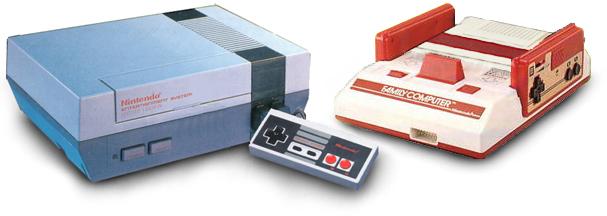 |
| Nintendo Enterrainment System on left, Nintendo Famicon on right |

The other company I'll be talking about is Marvel:
Marvel is an American comic book production company that is currently a
horizontally integrated subsidiary of the Walt Disney Corporation. The company
was founded in 1939 under the name "Timely Comics", super hero comic
books were becoming very popular in America at the time so publisher Martin
Goodman founded the company to produce and distribute "Marvel
Comics", a comic book featuring a series of short stories for the public
to read; after selling over 80,000 issues the company decided to publish and
distribute a second issue in the next month, this process continued for 18
years until the "Marvel Comics" became discontinued, in that time
however the company had created 3 new franchises: "Human Torch",
"Sub-Mariner" and "Captain America" which would take over,
thus forming the foundations the company uses to this very day. In 1951,
superheroes had fallen out of fashion, to keep the company going they started
to produce and distribute more general comic books featuring romance, mystery
and comedy as the subject matter; with such a radical change of themes they
renamed the company "Atlas Comics" and were able to survive, it
wasn't until 1958 that they successfully brought superheroes back in fashion
and returned to their routes. The company changed its name to
"Marvel" in 1961 to honour the name of their first publication, from
then on they gave the world some of its most famous characters including
"Spider Man", "The Avengers" and "The X-Men";
with Isaac Perlmutter working as the current CEO of the company, Marvel
continues to give the world some of the best media ever made.


No comments:
Post a Comment